When the IRS grants your organization 501(c)(3) status, you get valuable benefits in return: your donors can deduct their gifts, and your nonprofit is exempt from federal income tax. In exchange, the IRS asks for transparency. The public has to be able to see how a tax-exempt organization is run and where the money goes. Those public disclosure rules are the subject of this article: what you have to make available, which return you file, and by when.
This is a plain-English overview, not tax advice. Thresholds and forms change over time, so confirm the details for your situation with your accountant or on IRS.gov.
What does public disclosure mean?
Public disclosure means that anyone can review certain documents about your nonprofit, without needing a reason and without paying a fee to look. The idea is simple: because the public and your donors give up tax revenue to support your mission, they should be able to check that the money is actually spent on that mission. Transparency is the trade-off for tax-exempt status.
Which documents are public?
Two groups of documents are open to the public:
- Your three most recent annual information returns — that's your Form 990, 990-EZ, or 990-PF, including most schedules;
- Your application for exemption (Form 1023 or 1024) with its supporting documents, plus the IRS determination letter that granted your status.
One important exception: for most public charities, the names and addresses of individual donors (Schedule B) do not have to be shown to the public and can be redacted. Private foundations are treated differently, so check which rules apply to you.
Which Form 990 applies to you?
Which version you file depends mainly on your size. As a rough guide:
- Form 990-N (e-Postcard) — for small organizations with gross receipts that are normally $50,000 or less;
- Form 990-EZ — the short form, for mid-sized organizations under the IRS thresholds for gross receipts and total assets;
- Form 990 — the full return, once you cross those thresholds;
- Form 990-PF — for private foundations, regardless of size.
Not sure which one is yours? The current dollar thresholds are on IRS.gov, or your accountant can confirm it in a minute.
The core idea: show, in numbers and words, that the money goes toward the mission. Transparency isn't a formality, it's your most important trust-building tool with donors and funders.
When is it due?
Your Form 990 is due by the 15th day of the 5th month after your fiscal year ends. If your year matches the calendar, that's May 15. Need more time? You can request an automatic six-month extension with Form 8868. One warning worth repeating: if an organization fails to file for three years in a row, the IRS automatically revokes its tax-exempt status, and getting it back is a hassle.
How do you make it available?
You have to let people inspect the documents at your principal office during regular business hours, and provide copies on request (right away for in-person requests, within 30 days for written ones). You may charge a reasonable copying fee. There's a simpler path, though: if you make the documents widely available online — for example on your own website, or through a service like Candid (GuideStar) — you no longer have to mail out copies. Posting your recent Form 990s on your site, with a link in the footer, keeps you covered and builds trust at the same time.
Public disclosure checklist
- Have you filed the correct Form 990 for your size, on time?
- Are your three most recent returns available to the public?
- Are your exemption application and IRS determination letter on hand?
- Did you redact donor details (Schedule B) where you're allowed to?
- Are the documents easy to find, for example posted on your website with a footer link?
- Have you kept prior years available, so the history stays visible?
How Tutelium helps
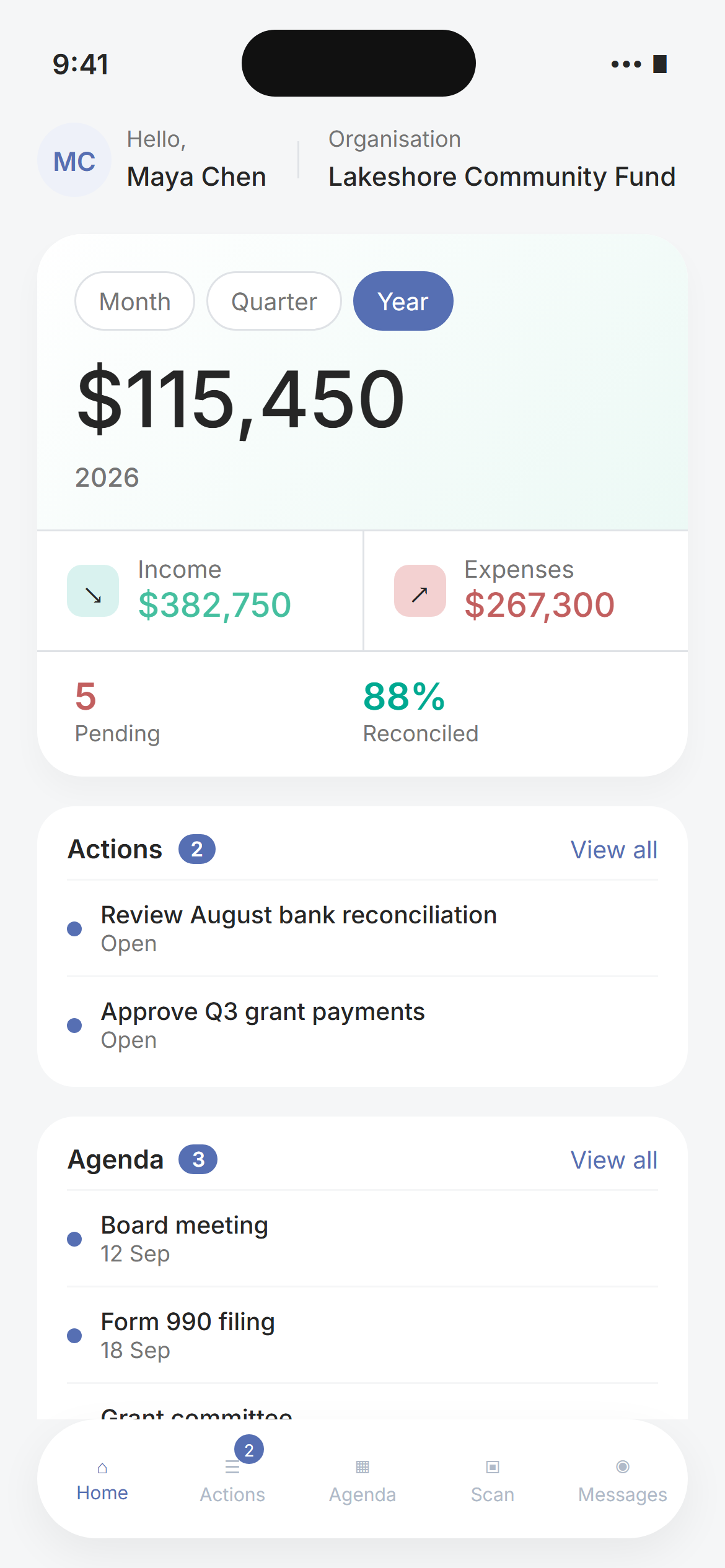
The hardest part of the disclosure rules usually isn't the rule itself, but getting the numbers in order. Tutelium keeps your books up to date all year, links receipts to transactions, and automatically organizes your income and expenses. By the time your fiscal year closes, the figures you need for Form 990 are largely ready. You just review the numbers and file.
Keep reading
Want to know how Tutelium works specifically for charities? Check out the page for charities, or read our article on important financial deadlines for nonprofits.